How to play Mines
Read the round from start to finish: grid size, mine selection, revealed tiles and the point at which a cash-out decision becomes available.

Explore the Mines game through clear guides to the grid, mine counts, multipliers and cash out. Understand how rules and odds change between versions, and what provably fair verification can tell you. Start with the essentials, then look closer at probability and common predictor claims.
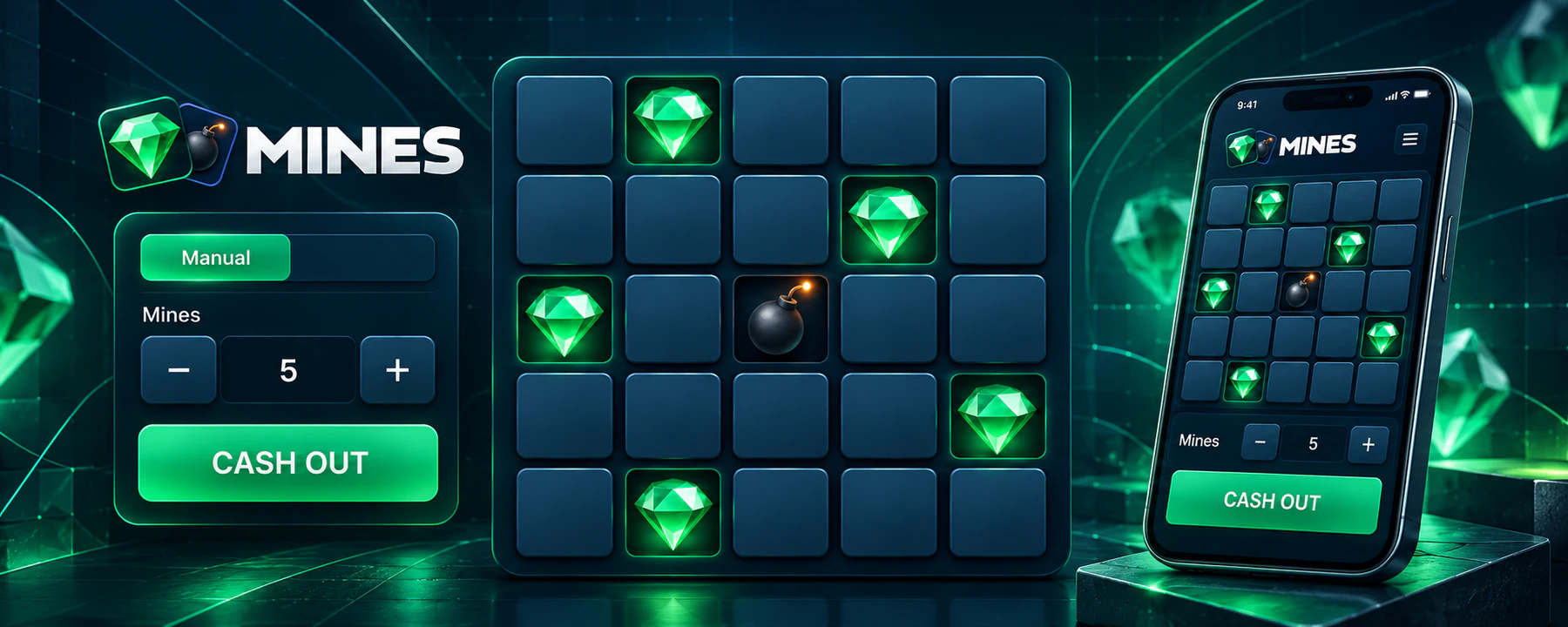
Build a clear understanding of the game, from the first covered tile to the probability behind a cash-out decision. Start with the essentials, then use focused guides to explore the details.
The Mines Guides library brings together explanations of game rules, mine counts, multipliers and mobile controls. Read each example alongside the rules of the version you are looking at: the same game name can describe different settings, payout tables and verification methods. A useful guide states its assumptions before drawing a conclusion, especially when it discusses risk or a supposed winning pattern.
Read the round from start to finish: grid size, mine selection, revealed tiles and the point at which a cash-out decision becomes available.
Follow the probability behind each reveal, separate a multiplier from a winning chance, and examine the limits of pattern-based approaches.
Use the article archive for focused explanations of game controls, probability, mobile interfaces and claims that deserve a closer check.
For a technical Mines guide, note the grid size, mine count and point at which the return is measured. Keep virtual-credit examples separate from account transactions. When two guides give different numbers, compare their rules and rounding before comparing their conclusions. A reproducible explanation should let you rebuild the example from its inputs.
Mines is a grid-reveal game built around hidden positions and a decision after each safe pick. Understanding the board and the return display is more useful than memorising a sequence of squares.

A common format uses 25 tiles arranged in a 5×5 board. Some contain mines and the rest are safe. Covered tiles look alike, so a visual route across the board does not reveal where a mine is hidden.
A safe reveal shows a gem and advances the round. The displayed multiplier describes the return available at that stage. Its value depends on the mine count, successful reveals and the specific payout rules.
Hitting a mine ends the round under the game’s rules. A completed board may then show the remaining positions. That final picture explains the past round; it is not a map for a new, independently generated board.
Classic Minesweeper normally supplies numbered clues about neighbouring mines. Many casino-style Mines versions do not provide those clues: identical covered tiles remain uncertain. Solving a numbered logic puzzle and choosing an unmarked tile are different tasks, even when both games use a square grid.
Covered tiles and revealed gems: a diagram of the game’s visual language.
Use a virtual-credit demonstration to learn the controls without confusing interface familiarity with predictive skill. The sequence below describes a common format; the provider’s own instructions take precedence.
Check the grid, number of mines, return display and rules before starting a practice round. Confirm whether the balance uses virtual credits and whether the payout figure includes the original stake. The meaning of a number matters as much as its size.
With more mines on the same board, fewer safe tiles remain. Changing the count changes both survival probability and the multiplier schedule. It does not make a particular corner, row or diagonal more informative on a uniformly random board.
When a safe tile opens, the number of covered tiles falls while the hidden mines remain. Read the updated return and any pending-action indicator. Repeated taps during a delayed response should not be treated as a reliable way to advance a round.
A cash-out action settles the current round according to its rules; a mine ends it differently. Use the resulting history to check settings, tile count and the recorded outcome. A pattern observed afterwards does not, by itself, explain the next result.
For a fuller walkthrough of the controls and terminology, use the how to play Mines guide. Keep the game version consistent when comparing examples.
Manual mode separates each reveal and decision. Automatic settings, where a version provides them, execute preselected instructions such as a tile sequence or stopping condition. Automation changes how actions are submitted; it does not expose hidden mine locations. Check the rules for interrupted rounds, limits and settlement before interpreting an automated result.
A screen animation acknowledges an interface action; the recorded round state is the evidence needed to review its outcome. When a response is delayed, check the game’s history and documented interruption rules before interpreting the display. A precise record pairs the round identifier with its settings and final state. It also distinguishes an open round, a request awaiting confirmation and a completed settlement, even if the version uses different labels for those stages.
Mine count and reveal count describe two different parts of risk. The probability of surviving a sequence is not the same as the chance that the very next tile is safe.
Assume a uniformly random board with 25 tiles, m hidden mines and k distinct safe reveals. There are no numbered clues, repeat picks or changes to mine placement during the round. The chance of completing all k reveals is:
P(k) = C(25 − m, k) ÷ C(25, k)After those safe reveals, the conditional chance for the next covered tile is (25 − m − k) ÷ (25 − k). With three mines and three safe reveals, the sequence survives about 66.96% of the time; the next tile is safe with probability 86.36%.
The zero-edge return reference is 1 ÷ P(k), including the original unit. It is a mathematical comparison, not a provider’s payable multiplier. Payout rounding, maximum returns and the actual paytable can change the return.
Uniform 5×5 board · mathematical model
Example: 3 mines and 3 safe reveals. Enable JavaScript to change the model.
| Hidden mines | First pick safe | All three picks safe |
|---|---|---|
| 1 | 96.00% | 88.00% |
| 3 | 88.00% | 66.96% |
| 5 | 80.00% | 49.57% |
| 10 | 60.00% | 19.78% |
RTP and house edge. A Mines RTP is version-specific. Return to player describes a long-run expectation under a stated model, not the fraction of rounds that win or the amount a short session will return. A high survival rate and a favourable expected return are separate measurements.
Read the paytable precisely. Check whether the displayed return includes the starting unit, how decimals are rounded and when a cap applies. A fixed return factor divided by P(k) is a common theoretical model; it should not be assumed for every game or reconstructed from a rounded display alone.
Take the stated 25-tile model with three mines and three safe reveals. There are C(22, 3) = 1,540 all-safe combinations out of C(25, 3) = 2,300 possible three-tile combinations. Survival probability is therefore 1,540 ÷ 2,300, or approximately 0.669565. The zero-edge total-return reference is approximately 1.493506×.
Now define a purely illustrative payoff: a successful one-unit round returns 1.40 units in total, and an unsuccessful round returns zero. Expected total return is P × 1.40 = 0.937391 units. Subtracting the starting unit gives an expected net result of −0.062609 units. This is an explanation of a defined payoff, not a quoted live paytable.
A favourable individual outcome and a favourable mathematical expectation are different properties.
A return rounded for display may differ from the value used for settlement. Calculate expected return from the actual payout rule, including any cap, minimum or rounding convention. A short session can finish above or below its expectation; that variation does not change the theoretical calculation. Likewise, a history that records only successful rounds cannot be used to estimate RTP.
A meaningful fairness check starts with a documented method and the exact data from a completed round. A badge or a familiar game name cannot replace a reproducible calculation.

In a seed-based implementation, a server-seed hash is published before play. Save the commitment and the relevant round identifier. A hash can commit to a value without revealing the seed while it is still in use.
After the seed is revealed through the provider’s process, check the hash and reproduce the outcome using the correct client seed, nonce and documented mapping. Some implementations also use a cursor; the input format and tile order matter.
Compare the reconstructed mine positions with the recorded round and settings. A correct match supports consistency with that implementation. A mismatch needs investigation of the inputs, algorithm version and recorded data before a conclusion is drawn.
Keep the commitment as originally shown, the revealed seed when available, the client input, round counter and game settings. The verifier also needs the exact input encoding and the published conversion into tile positions. A seed-hash match alone does not reproduce the board: byte conversion, tile numbering and the rule that prevents duplicate positions are part of the calculation.
If two tools disagree, first compare the version, input formatting, counter numbering and tile orientation. A verifier written for another implementation can return a different board even when each tool is internally consistent. Preserve a known test vector so the calculation can be repeated. Commitment verification, board reconstruction and evaluation of the source randomness answer related but distinct questions.
A useful Mines strategy explains which decisions change exposure and which assumptions the calculation needs. It does not turn a hidden random layout into an observable one.
Separate the settings. Mine count determines how many safe tiles exist. Reveal count determines how far a sequence must survive. Compare both variables together instead of judging a round by its potential multiplier alone.
Treat equivalent tiles equally. On a uniformly random, unmarked board, corners and centre tiles have the same prior safety probability. A diagonal, repeating pattern or recently successful route does not gain information about a fresh board.
Define a practice question. Use virtual credits to compare a specific rule or control setting, and record the settings as well as the outcome. A small run of successful rounds is weak evidence: random variation can easily produce memorable streaks.
Keep history in context. Independent rounds do not become due for a win after losses. Increasing an amount after a loss does not repair the probability model and can sharply increase exposure. A stopping rule changes session length, not hidden information.
For the calculations behind these decisions, read Mines strategy and odds. Compare survival probability, expected return and variability as separate quantities; none is a guarantee for the next outcome.
With three mines on a 25-tile board, a first pick is safe with probability 0.88. Across three independent fresh boards with the same settings, three safe first picks have probability 0.88³ = 0.681472, about 68.15%. Inside one unchanged board, three consecutive safe reveals have probability about 66.96%, because each safe reveal reduces the remaining safe-tile proportion.
That distinction explains why resetting a demonstration and continuing a sequence are different experiments. It does not make a particular tile informative. Compare complete samples with the same rules, and report variability alongside an average result. A predefined stopping condition can limit the length of an exercise, but it supplies no new information about a covered tile.
The grid may look familiar on a phone, but screen size, network state and software provenance deserve separate attention. A search result labelled “Mines app” does not identify one universal product.
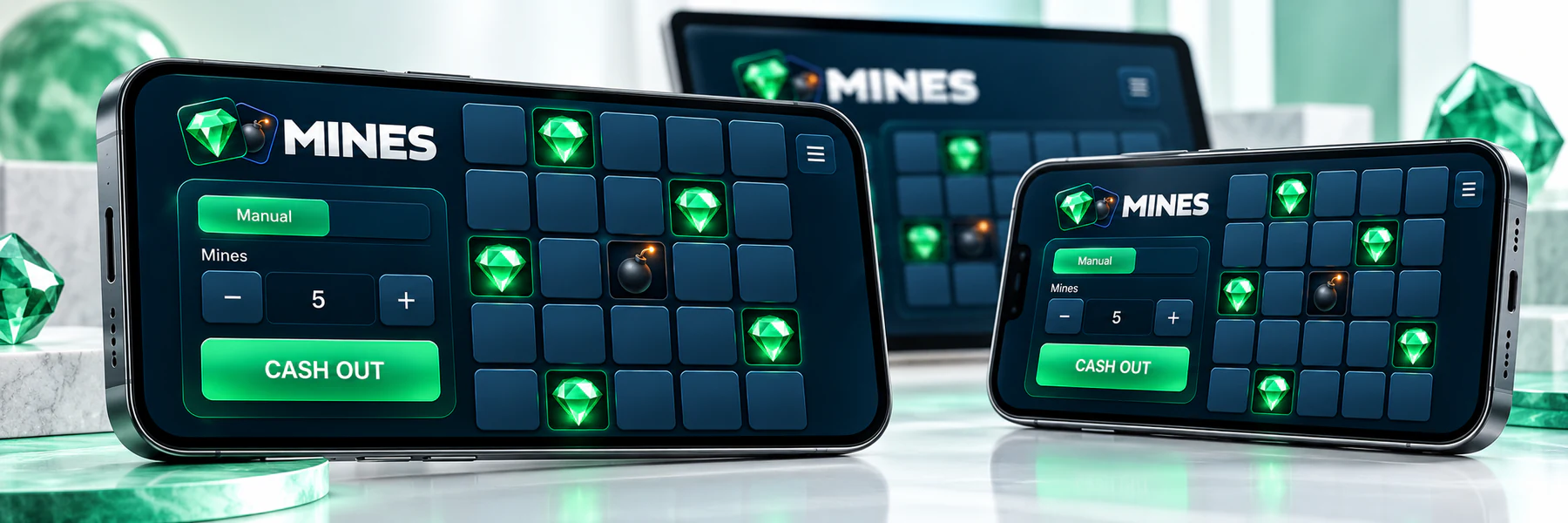
Some versions run in a mobile browser without an installation. Use a current browser, keep zoom available and choose an orientation that makes the grid and controls readable. Check that the amount, mine count and action state remain visible before interacting with a control.
If a connection drops, wait for the round state or history to synchronise. Do not assume that a missing animation means an action failed, or repeatedly submit actions to compensate for a delayed response.
For any Mines game app or Android APK, verify the publisher, source and purpose. A virtual-coin puzzle, a provider’s demo and an account-based gaming service can share similar names and graphics while working very differently.
Review permissions and update information before installation. App availability, supported devices and the meaning of an in-app balance need to be checked for the particular product; a familiar gem icon establishes none of those details.
Check how the particular version presents pending actions, completed history and a resumed tab. Returning from another app can leave an old frame on screen until the state is refreshed. Interpret the recorded round rather than relying on the last visible animation. Keep the browser or application updated, and review the source of an installation separately from the appearance of its icon.
For a demo, confirm whether credits reset and whether they can be redeemed; virtual balances commonly exist only for practice. Neither a rupee symbol nor an app-store-style graphic establishes a payment feature, a provider relationship or permission to offer the product in India.
Clear answers to the rules, odds, fairness and mobile questions that matter when reading about Mines online. Examples use the stated model; version-specific rules still need to be checked.
For the numbers behind an answer, compare the probability explorer with the mine-count table above. Keep a completed-round check separate from a claim about future results.
Mines is a hidden-tile game in which safe reveals advance a round and a mine ends it under the game’s rules. A common version has 25 tiles, but Mines is a game type rather than one universal app or paytable. Identify the provider and settings when comparing examples.
A multiplier represents a return relative to the starting unit. Check whether it includes that original unit. Higher displayed returns commonly accompany less likely safe sequences, but the exact values depend on the paytable, rounding and any return cap. A multiplier is not itself a probability.
There is no mine count that guarantees a favourable outcome. Fewer mines leave more safe tiles on the same grid, while more mines make a safe reveal less likely. Compare the mine count, intended reveal count and actual payout rules together; “best” needs a defined objective and does not remove uncertainty.
On a fixed board, a safe pick removes one safe tile while all mines remain hidden. The next-pick safety probability therefore falls. With 25 tiles and three mines, it starts at 22/25. After three safe reveals, it is 19/22. This within-round change is different from the independence of fresh rounds.
No guarantee follows from a claimed pattern, recent results or a public seed hash. A valid claim of advance knowledge would need independently reproducible evidence obtained before outcomes were known. Selected winning screenshots do not supply that evidence. Treat requests for account credentials or unexplained software permissions as a reason to stop.
No. Provider versions can use different payout models and published RTP values. The probability explorer here models a uniform 25-tile board and shows a zero-edge mathematical reference; it does not declare an RTP for every Mines product. Use the identified version’s documented rules to assess its expected return.
A documented verification process lets you check a completed result after the required seed data becomes available. It does not reveal a seed that is still secret or make future mine locations visible. Record the commitment, settings and round inputs, then use the implementation-specific method to reproduce the result.
That depends on the version. Some demos work in a browser with virtual credits; others are delivered as separate applications. Check the actual publisher and rules instead of assuming every Mines download is the same product. A download is not required by the mathematical mechanics of a tile-reveal game.
India’s Promotion and Regulation of Online Gaming Act, 2025 and the 2026 framework prohibit online money games and associated promotion. A website being accessible, or displaying rupee amounts, does not establish lawful availability. This page explains game mechanics; check the current official position and the classification of the particular product.
New Mines Guides articles are collected in the guide library and the recent-reading area near the top of this page. Start with the core how-to and strategy pages, then choose a focused article to explore a particular control, calculation or interface question in more detail.
Cash out refers to settling the current game round under its rules. A withdrawal is a separate account transaction that may involve identity checks, processing rules and legal restrictions. In a virtual-credit demo, the balance may have no cash value at all. Read what a balance represents before interpreting a return figure.
RTP is a long-run expectation for a specified payoff model, while a small sample contains random variation. Selected winning sessions also omit the losses that would be needed for a fair comparison. Record every attempt, its settings and its complete result; a short favourable sequence does not identify an advantage.
